Tool Curator Architecture
Dense retrieval, sparse retrieval, and a rank-based fusion — plus four mechanisms layered on top that exist because the reference evaluation found the core three weren't quite enough on their own.
Why simpler approaches aren’t enough
Role-based filtering alone cuts a 191-tool registry down to a persona’s slice (say, 87 tools for a student), but 87 is still too many for reliable single-query selection, and filtering by role does nothing to reflect that any one question only needs one or two of them.
TF-IDF keyword retrieval catches exact terminology but misses paraphrase — “raise a formal complaint” scores nothing against submit_grievance unless the synonym file already spells that mapping out.
Dense retrieval alone closes the paraphrase gap but can dilute precise-terminology matches (“CGPA” competing against several semantically-similar tools) and gives no way to force a plainly-named tool to the top when it’s the obvious match.
The curator combines dense and sparse retrieval specifically because their failure modes don’t overlap.

select() pipeline for one query, left to right.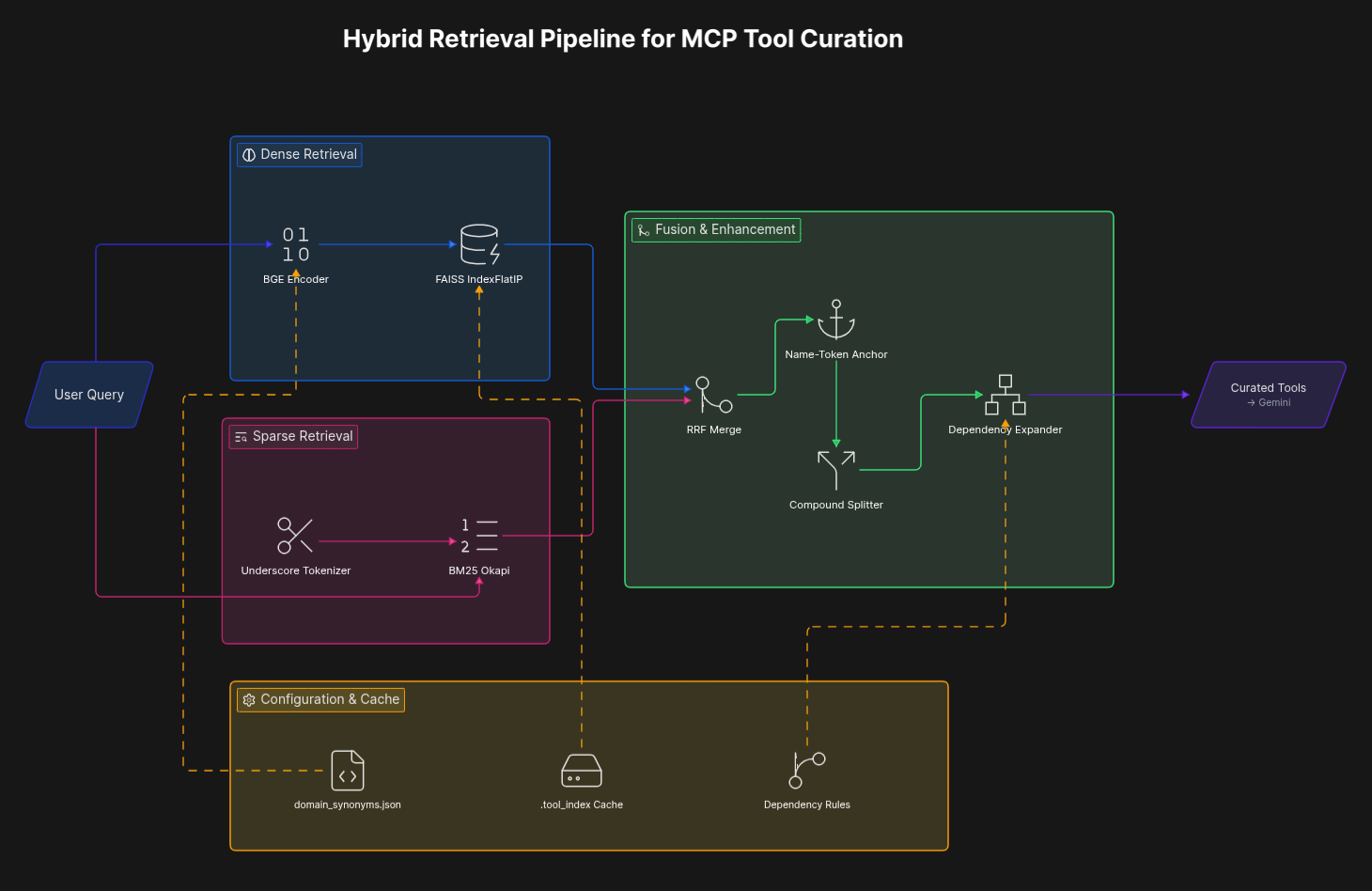
Dense retrieval — BGE + FAISS
BAAI/bge-small-en-v1.5 (130MB, 384 dimensions) is trained for asymmetric retrieval — short queries against longer descriptions, which is exactly the query-vs-tool-description shape. BGE requires a query-side prefix that documents don’t get:
BGE_QUERY_PREFIX = "Represent this sentence: "
q_emb = model.encode(BGE_QUERY_PREFIX + query, normalize_embeddings=True).astype(np.float32)
Embeddings are L2-normalized, so FAISS IndexFlatIP (exact inner-product search) is equivalent to cosine similarity. For a few hundred tools at 384 dimensions the whole index is under a megabyte and search completes in under a millisecond on CPU — this is what closes the gap between “what is my available balance?” and a tool named get_account_summary that shares no words with the query.
Sparse retrieval — BM25
BM25Okapi from rank_bm25, tokenized on whitespace and underscores:
def _tokenize(text: str) -> list[str]:
    text = text.lower()
    text = re.sub(r"[^a-z0-9\s_]", " ", text)
    return [t for t in re.split(r"[\s_]+", text) if len(t) > 1]
get_account_summary tokenizes to ['get', 'account', 'summary'], so the word “summary” in a query scores against it directly — this is also why tool documents are built with underscores expanded to spaces before indexing (see What gets indexed below). BM25 also applies term-frequency saturation: mentioning “transfer” ten times gives roughly a 3× boost, not a 10× one, unlike TF-IDF’s linear scaling.
Zero-score guard. When a query shares no vocabulary with any tool, every BM25 score is exactly zero, and sorting zero-score ties by insertion order would inject arbitrary noise into the fusion step below. The curator detects this and skips BM25 entirely for that query — dense retrieval carries the result alone:
max_bm25 = max((s for s, _ in pool_raw), default=0.0)
if max_bm25 > 1e-9:
    sparse_ranked = [...]   # normal path
# else: every BM25 score is zero — skip sparse retrieval for this query.
This was found during evaluation, not designed upfront — worth testing specifically if you’re combining dense and sparse retrieval elsewhere.
Fusion — Reciprocal Rank Fusion
Dense and sparse scores live on incompatible scales, so fusion uses rank position only, not the raw scores:
RRF_K = 60   # standard constant from the original RRF paper
def _rrf_merge(dense, sparse, k=RRF_K):
    scores = {}
    for rank, (name, _) in enumerate(dense, 1):
        scores[name] = scores.get(name, 0.0) + 1.0 / (k + rank)
    for rank, (name, _) in enumerate(sparse, 1):
        scores[name] = scores.get(name, 0.0) + 1.0 / (k + rank)
    return scores
A tool ranked #1 in both lists scores 1/61 + 1/61 ≈ 0.033; a tool only in dense at rank 25 scores 1/85 ≈ 0.012 — tools both retrievers agree on float to the top, and k=60 flattens the curve enough that one strong single-retriever signal can still outweigh a weak dual-retriever one. No score normalization is required anywhere in this step.
Name-token anchor
RRF handles the general case, but nothing guarantees a tool whose name directly matches the query survives to the top-k on rank alone. The anchor runs after fusion:
ALWAYS_INC_RATIO = 0.60
def _always_include(query: str, tool_name: str) -> bool:
    tokens = [t for t in tool_name.lower().split("_") if len(t) > 3]
    if not tokens:
        return False
    hit_ratio = sum(1 for t in tokens if t in query.lower()) / len(tokens)
    return hit_ratio >= ALWAYS_INC_RATIO
A query containing “hostel leave” against apply_for_hostel_leave hits 2 of 3 meaningful tokens (67%) and clears the 60% bar, so its RRF score is forced to 999 — guaranteed inclusion regardless of where fusion ranked it. The 60% threshold exists specifically to stop long tool names from being force-included by one incidental word.
Compound query splitting
A query like “show my attendance and also raise a grievance” encodes as a single blended vector sitting between two tool clusters, under-ranking both. A deliberately narrow set of split markers triggers decomposition:
_SPLIT_RE = re.compile(
    r"\b(?:and\s+then|and\s+also|after\s+that|additionally|"
    r",\s*then|,\s*and\s+also|then\s+also|as\s+well\s+as|"
    r"along\s+with|then|also|plus)\b",
    re.IGNORECASE,
)
Plain “and” and “or” are intentionally excluded — they’re too common in ordinary single-intent queries (“show my accounts and balances”) to safely treat as an intent boundary. When a split marker is detected: each sub-query retrieves independently with a budget of max(top_k // parts + 2, 7), results are unioned, and the full unsplit query runs once more as a top-up pass to catch cross-intent tools that only make sense given the whole query.
Low-confidence expansion
After fusion, if the strongest dense similarity is still weak, the match itself is probably weak, not just the ranking:
LOW_CONF_SIM = 0.25
CONF_BOOST   = 5
if max_sim < LOW_CONF_SIM:
    effective_k = min(top_k + CONF_BOOST, len(tools))
At the default top_k=20, a low-confidence query gets 25 tools back instead of 20 — a small hedge against a genuinely ambiguous or oddly-phrased query, at the cost of a slightly larger declaration set for that one turn.
Disk cache
The FAISS index and embeddings are persisted to index_dir, keyed by an MD5 hash of every (tool_name, description) pair plus the domain-synonym content:
def _pool_hash(tools):
    blob = json.dumps(sorted(tools), sort_keys=True).encode()
    return hashlib.md5(blob).hexdigest()[:16]
First build for a few hundred tools: a couple of seconds (embedding + FAISS + BM25 construction). Every subsequent process start with the same tool set and synonym file: well under 100ms, loaded straight from disk. Editing a tool description or domain_synonyms.json changes the hash, which invalidates the cache automatically on the next build_index() call — no manual cache-clearing step exists or is needed.
What gets indexed
Each tool is indexed over more than its bare description:
def _build_text(name, desc, extra=""):
    human = name.replace("_", " ")   # underscores -> spaces, so BM25 matches word-by-word
    parts = [human, desc.strip()]
    if extra:
        parts.append(extra.strip())
    return " ".join(p for p in parts if p)
extra is exactly the per-tool string supplied via extra_context in build_index() — see Configuration & Domain Synonyms for how that string is authored and why it’s the single highest-leverage lever for retrieval accuracy on a new domain.