Evaluation & Results
Methodology, rubric, and the full reference-deployment results — plus how to reproduce them with the bundled harness.
Methodology
The curator was evaluated against a manually curated 281-query hand-labeled suite (example/eval/MCP_Evaluation_Sheet_-_TF_IDF_Tool_Curator.xlsx), spanning multiple personas and seven query categories:
| Category | Count |
|---|---|
| Single-Tool Direct | 189 |
| Multi-Tool Complex | 25 |
| Semantic / Paraphrase | 24 |
| Edge Case / Negative | 21 |
| Access Denied | 7 |
| Need Clarification | 7 |
| No Tool | 8 |
Each case was labeled Correct, Partially Correct (some but not all expected tools selected), Wrong (incorrect tool invoked), or Skipped (no suitable tool surfaced). The accuracy score:
Accuracy Score = (Correct + 0.5 × Partially Correct) / Total Queries
These three categories test full-system behavior (persona access control, the model's own decision to ask a clarifying question) rather than retrieval — the curator has no mechanism to signal "no relevant tool exists." curator_eval.py reports these separately rather than scoring them against hit@k.
Results
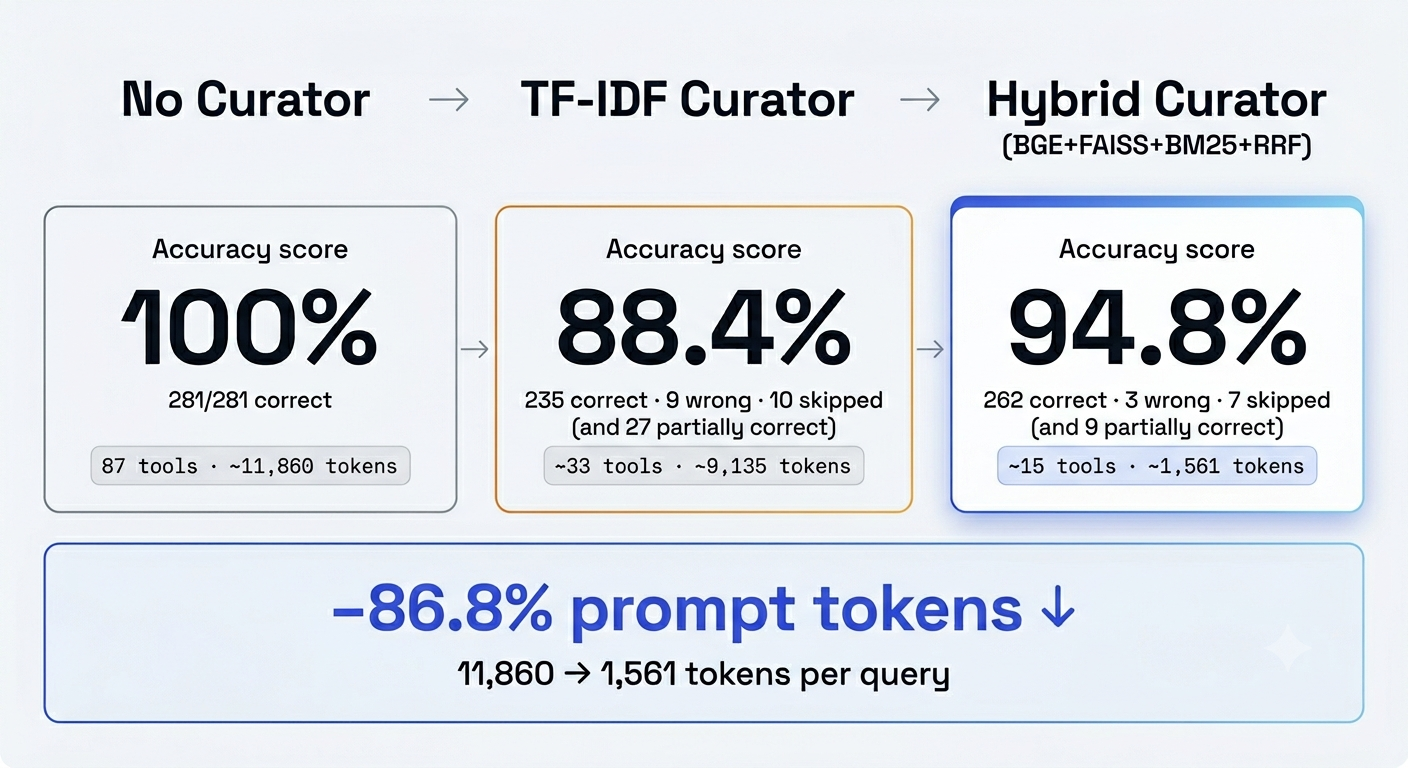
| Version | Correct | Partial | Wrong | Skipped | Correct % | Accuracy score |
|---|---|---|---|---|---|---|
| No curator, original descriptions | ~225/281 | — | — | — | ~80% | ~80% |
| No curator, refined descriptions | 281/281 | 0 | 0 | 0 | 100.0% | 100.0% |
| TF-IDF curator | 235/281 | 27 | 9 | 10 | 83.6% | 88.4% |
| Hybrid curator | 262/281 | 9 | 3 | 7 | 93.2% | 94.8% |
The 100% no-curator row is a ceiling, not a deployment target — it costs roughly 11,860 prompt tokens per query (87 role-permitted tools sent unfiltered, before the user has even asked anything). The curator’s goal is approaching that ceiling while cutting the token cost by an order of magnitude.
Token impact
| Version | Tools sent | Prompt tokens, first student query |
|---|---|---|
| No curator | 87 | ~11,860 |
| TF-IDF curator | ~33 (top-15 + all action tools) | ~9,135 |
| Hybrid curator | ~15 | ~1,561 |
The hybrid curator’s 86.8% token reduction relative to the no-curator baseline comes with a 93.2%→94.8% accuracy improvement over the TF-IDF version, not a trade-off against it — the gap between TF-IDF’s ~33 tools and the hybrid’s ~15 is mostly TF-IDF’s blanket “always include every action tool” rule, versus the hybrid’s targeted, retrieval-driven dependency expansion.
Per-query latency breakdown: roughly 15ms for BGE query encoding, under 1ms each for FAISS and BM25 search — under 2% of total response latency against the 1–3 second range typical of the LLM call itself.
Reproducing these numbers
cd example
python eval/collect_tools.py                 # snapshot all 191 tool descriptions once
python eval/curator_eval.py --top-k 15        # hit@k / recall@k against the bundled sheet
python eval/curator_eval.py --top-k 15 --lenient   # score using equivalences.json covers/aliases
No live LLM call happens in either script — collect_tools.py needs the MCP servers reachable once, and curator_eval.py runs entirely against the cached snapshot afterward. See Configuration & Domain Synonyms for the iteration loop this harness is meant to support on your own domain.